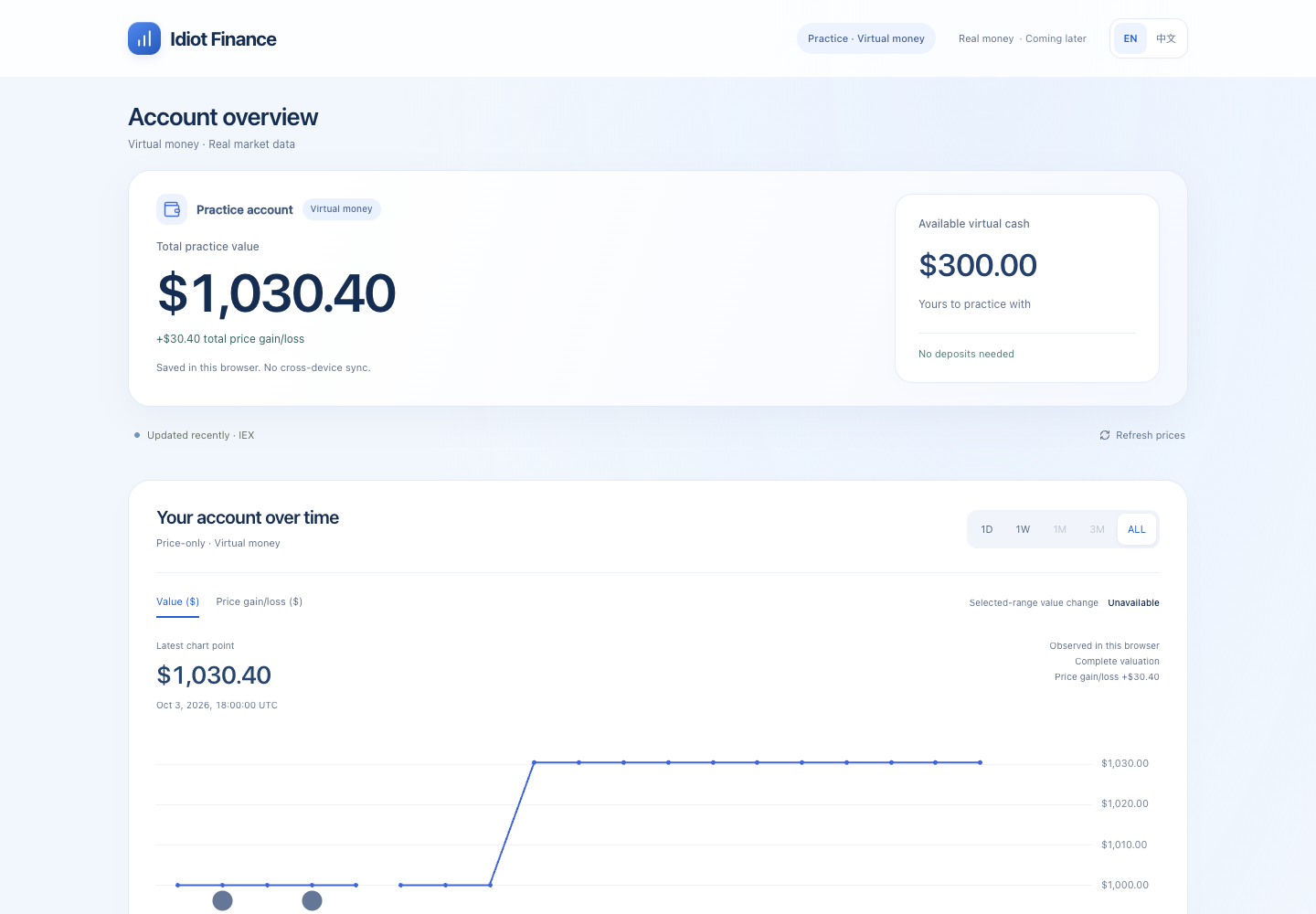
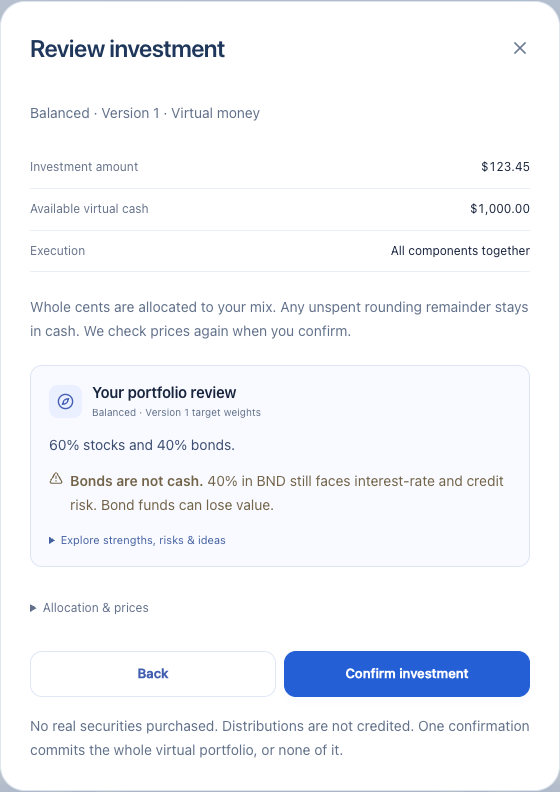
Idiot Finance lets a learner explore preset and custom ETF portfolios with virtual money. The application makes allocation, review, transaction state, and historical research understandable while keeping calculations and failure handling explicit.
An investing simulation loses credibility if duplicate clicks change the balance twice, edited weights rewrite an existing position, or missing prices quietly become a convincing chart. The interface and financial state need to agree.
Preset and custom portfolios share a simulation engine. A browser-local practice account and a read-only historical research path have different purposes and calculation rules.
How it works
01
Preset / custom definition
02
Review + state revisions
03
Read-only market / synthetic adapter
04
Precise simulation engine
05
Versioned browser state + recovery
From input to output
01Define a preset or a valid custom allocation, with weights and versions made explicit.
02Capture a reviewable virtual transaction before fetching eligible market observations.
03Recheck account and definition revisions, calculate the complete basket, and persist one account update.
04Keep historical price simulations read-only, expose missing coverage, and validate backups before replacing saved state.
Data sources
Deterministic synthetic prices in the isolated offline demonstration
Read-only Alpaca market bars and calendar endpoints in the configured market-data path
Versioned portfolio definitions and browser-local simulation records
Technical approach
Integer cents, scaled prices and units, BigInt arithmetic, and explicit rounding for virtual transactions
Immutable definition snapshots and request IDs for reproducible account actions
Web Locks and revision checks for browser-local coordination
Separate historical price-only calculations with explicit source coverage
Validated migration and backup restore with a fresh storage generation
What you can inspect
Preset and custom portfolio simulation
Review screens and virtual transaction receipts
Holdings and allocation views tied to saved definitions
Historical price-only comparison with visible data gaps
Local backup and restore workflow
An existing position keeps the definition used when it was created; editing a draft creates a separate version.
An accepted duplicate command returns its prior receipt rather than creating a second virtual transaction.
Incomplete historical coverage withholds unsupported full-period metrics, and research does not spend practice cash.
The deliverable is an investing simulation whose account changes and chart limitations can be inspected. The engineering evidence is in the arithmetic, state transitions, and rejected operations.
Illustrative demo · Synthetic data. A review step precedes a virtual account update.
Where this is useful
Shows how financial domain rules become precise application behavior.
The same state and validation patterns are relevant to internal tools that must preserve a consistent record through retries and recovery.
Existing release artifacts separately record unit/API checks, browser scenarios, synthetic fixtures, and limited provider observations. Historical results are not represented as newly executed portfolio tests.
The displayed account and prices are synthetic. They demonstrate UI and state behavior, not investment performance.
Key decisions
Keep virtual execution arithmetic separate from read-only historical research calculations.
Commit the whole virtual basket or reject it; a partial account update is not a completed transaction.
Pin a position's definition so later draft edits cannot rewrite its history.
Keep stale and missing market coverage visible, and withhold metrics that lack sufficient data.
Validate saved state before restore and use a new storage generation to reject stale in-flight actions.
The implemented command includes an identity, account revision, and definition version so confirmation can be checked against the state that was reviewed.
Role & status
Personal product and application development with AI coding assistance. The scope shown here includes the simulation experience, portfolio calculations, versioned account state, data-gap handling, and review of unit and browser evidence.
AI coding tools assisted development. The case presents implementation and verification artifacts, not a claim that all code was written independently or that simulated gains are a personal investment track record.
This is a virtual-investing application; it does not place real securities orders or provide personalized investment advice.
Guest account state is local to the browser and is not secure custody or a multi-user account service.
Historical research is price-only; corporate-action support is bounded and does not establish complete total-return modeling.
The portfolio uses an illustrative synthetic-data view. No public product endpoint or public source repository is linked.
Explore the evidence
Source review: portfolio engine and store, architecture, research backtest, backup policy, and release verification artifacts. Existing release evidence is historical; no market-data calls or project tests were run for the portfolio source review.