The problem
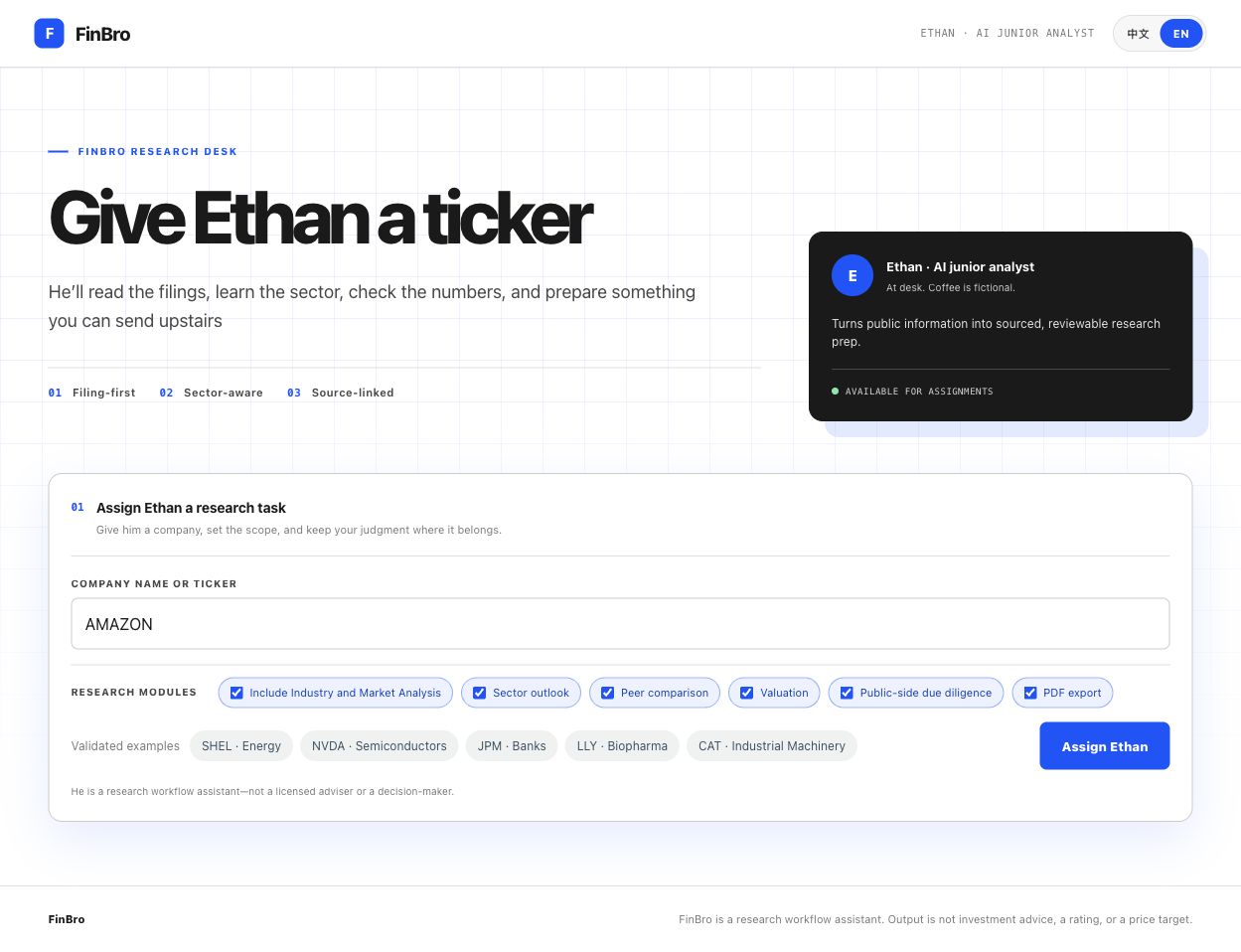
Ethan connects public financial sources to a repeatable reporting workflow. A company identifier becomes a structured research object, then a readable report with financial tables, charts, metric definitions, and source references.
An analyst can collect filings quickly and still spend substantial effort reconciling periods, units, missing values, and inconsistent report surfaces. The output needs to remain checkable after that preparation work.
Ethan and Clara belong to the same FinBro application. Ethan focuses on public-company financial information; Clara handles evidence-led company research with a different tool and state model.
How it works
- 01
Resolved company identity
- 02
SEC / public-source adapters
- 03
Canonical metric registry
- 04
Formula, period and source checks
- 05
Shared web / PDF report model
From input to output
- 01Resolve the company identity and use SEC information to classify the research target.
- 02Collect filing and financial facts through source-specific adapters rather than treating search text as a financial database.
- 03Normalize values into canonical metrics that retain period, currency, unit, formula inputs, and source lineage.
- 04Check metric consistency before rendering the same research data as a web report or PDF.
Data sources
- SEC Submissions and Company Facts / XBRL
- Public filings, filing exhibits, and investor materials where supported
- A public Shell research example retained in the FinBro repository
Technical approach
- Deterministic identity resolution, metric selection, and financial calculations
- Canonical metric registry with source, period, and calculation metadata
- Explicit missing-value and availability states
- Consistency checks across report values, formulas, tables, charts, and exports
What you can inspect
- Structured public-company research object
- Source-linked financial report
- Financial tables and charts backed by shared metric data
- Web and PDF renderings plus a source register
- Report values can be traced to their canonical metric, definition, period, and source.
- The repository includes a public research example with Markdown, chart assets, and a PDF rendition.
- Shared report data reduces the risk of a chart, table, and export silently using different figures.
The deliverable is a report a reader can inspect: identify the company, follow a figure to its source, and see which inputs are unavailable.
Where this is useful
- Useful for preparing public-company briefs and repeatable financial reporting.
- The same approach applies when a business needs consistent source-backed tables across multiple reporting formats.
Checks & engineering decisions
Verification evidence
- Source review confirms checks for missing canonical inputs, period / unit / currency mismatches, source lineage, and inconsistent report values.
- The public Shell example can be inspected alongside its Markdown, chart assets, and PDF. It is a retained example rather than a new provider run.
- The portfolio review did not execute research tasks or establish a new live accuracy or performance benchmark.
Key decisions
- Keep financial data processing deterministic and distinguish it from optional model-assisted decisions elsewhere in FinBro.
- Use raw canonical values for calculations and format values only at the presentation boundary.
- Retain definitions, formula inputs, periods, and sources so a reader can reproduce a reported metric.
- Render tables, charts, web pages, and PDF output from shared research data.
A metric keeps its provenance
typescripttype CanonicalMetricObject = {
canonical_key: string;
period: string;
value: number | null;
unit: string;
currency: string | null;
source_document: string | null;
source_url: string | null;
input_metric_keys: string[];
// Additional definition, status and version fields omitted.
};
Selected fields from the implemented canonical metric type. A number travels with its reporting period and evidence rather than becoming an unexplained string in a report.
Role & status
Personal product and application development with AI coding assistance. The work presented here covers public-data integration, financial-metric handling, report structure, and review of implementation checks.
AI coding tools assisted implementation. This case documents the project's workflow and evidence; it does not imply that every line was written independently.
Implemented workflow · Public FinBro website · Provider-dependent research Source review: 2026-10-14.
Limitations
- Coverage depends on the company, filing availability, and supported metric definitions.
- Public-company data handling is primarily deterministic; it is not evidence of unrestricted LLM reasoning.
- The repository sample is an existing example, not a fresh production run performed for this portfolio.
- The public FinBro landing and initial workflow page can be visited; a full research run may require configured providers and is not guaranteed by page availability.
Explore the evidence
Source review: FinBro product and architecture documentation, canonical-metrics.ts, metric-consistency-auditor.ts, report-rendering-model.ts, and the public Shell example. The evidence date records a source review, not a newly executed provider workflow.