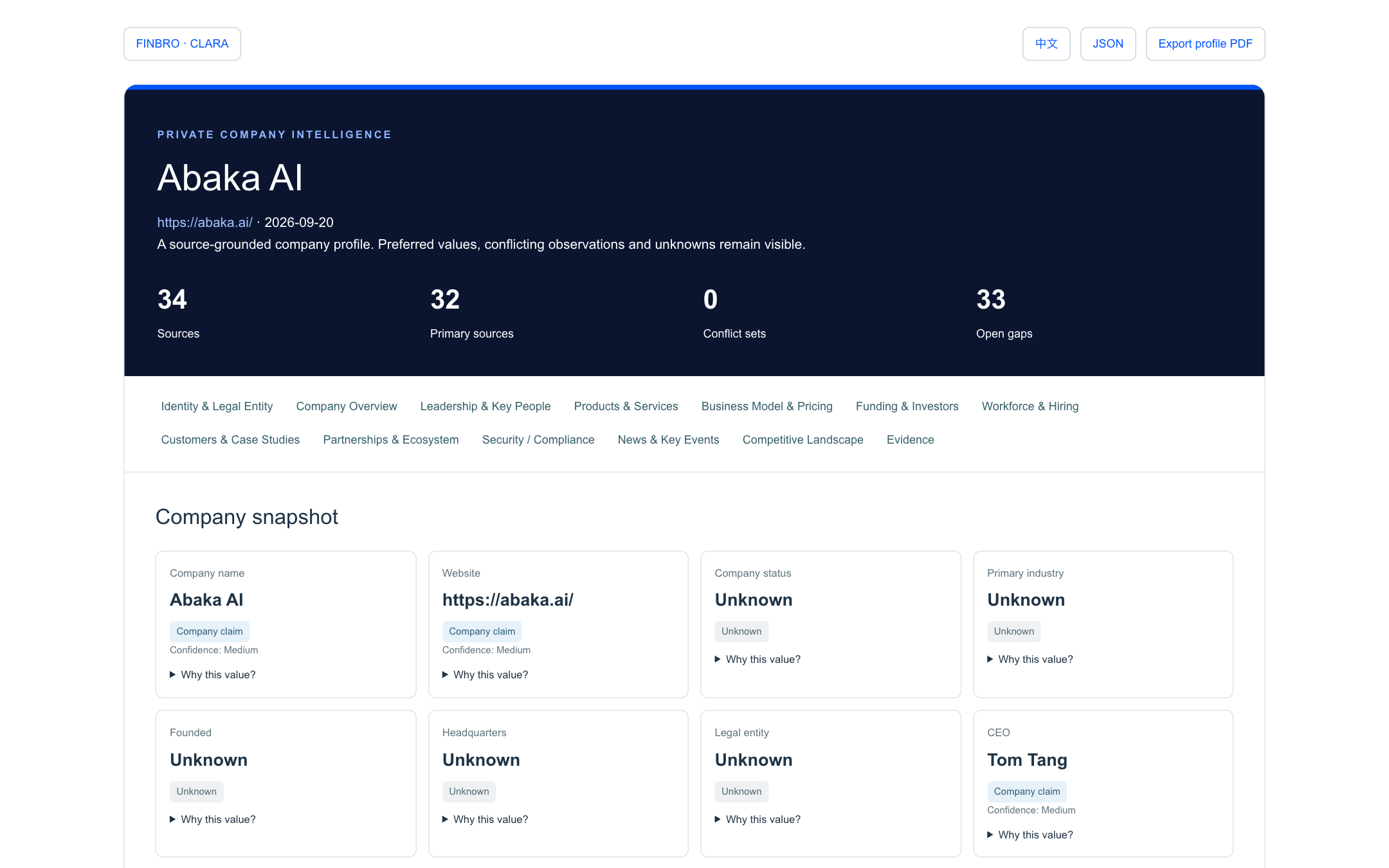
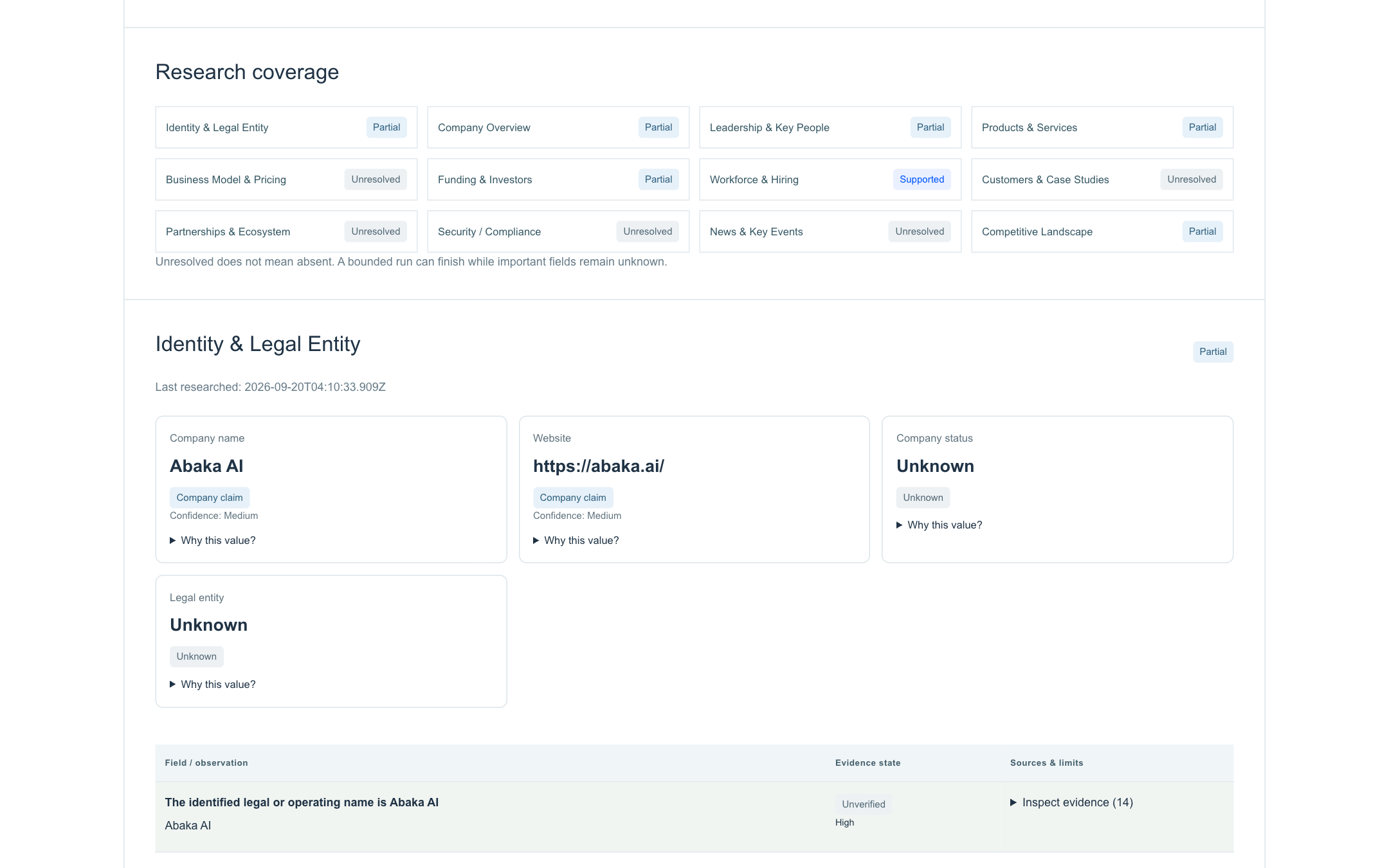
Actual FinBro UI · Archived public-source research snapshot, September 2026
The problem
Clara assembles company research around a confirmed target. It collects public evidence through bounded tools, preserves sources and unresolved gaps, and produces a structured brief that makes incomplete research visible.
Public company information is scattered, names are ambiguous, and a search result may contain a company's own claim rather than independent confirmation. A polished summary alone cannot show what was actually checked.
Clara is FinBro's company-research workflow, alongside Ethan's public-company reporting path. Its purpose is a grounded company brief rather than an open-ended chat interface.
How it works
01
Confirmed company target
02
Allowlisted research tools
03
Evidence + execution history
04
Deterministic coverage assessment
05
Validated bounded next action
From input to output
01Resolve and confirm the company before permitting research tools to act on it.
02Collect original-page evidence, hiring signals, and funding leads through an allowlisted registry.
03Store evidence references, observations, information gaps, and tool-attempt history in research state.
04Assess coverage, validate a structured next-action decision, execute an allowed step, and assess the updated state.
Data sources
Confirmed company websites and original public pages
Bounded search-discovery leads and public hiring sources
Public funding announcements and SEC funding records where a verifiable match is available
Technical approach
Five registered tools: company identity, web research, hiring intelligence, funding search, and SEC funding
Typed success, partial, and failed results with evidence IDs and retrieval times
LibSQL-compatible persistence for research state and execution history
Deterministic coverage checks and validation of structured planner decisions
Confirmation, retry, duplicate-work, and high-severity-gap guards
What you can inspect
Structured company brief
Evidence and source register
Information-gap and conflict records
Inspectable tool-execution history and coverage status
A source reference remains attached to an observation rather than being lost in generated prose.
Partial evidence and failed execution are separate states, allowing useful findings to survive an incomplete attempt.
The single-step planner service validates its decision before executing at most one tool and then rechecks coverage.
The result is a company-research artifact that shows what supports a finding, what remains unknown, and which actions produced the evidence.
Actual FinBro UI · Archived public-source snapshot. Coverage and gaps accompany the report; this is not a new research run.
Where this is useful
Useful for company briefs, competitor research, and vendor or prospect screening with human review.
A visible gap is actionable: the reviewer can request a specific source or stop research instead of accepting a fabricated answer.
Checks & engineering decisions
Verification evidence
Reviewed fixtures cover unconfirmed-target rejection, partial results, valid zero-job outcomes, retries, and open high-severity gaps.
The implemented tool contract distinguishes incomplete evidence from execution failure and keeps source references attached to observations.
Role & status
Personal product and application development with AI coding assistance. The scope presented here includes research-tool contracts, structured company reports, durable state, and review of failure and planning fixtures.
AI coding tools assisted implementation. Personal contribution is presented as project development and review, without claiming independent authorship of all code or a measured model-quality improvement.
Implemented workflow · Bounded planning · Deeper diligence in development Source review: 2026-10-14.
Limitations
A registered adapter does not guarantee a successful live source match or provider entitlement.
Company-reported statements remain distinct from independently verified facts; evidence quantity alone does not establish coverage.
The single-step planning service is bounded; deeper diligence workflows and other research modes have separate implementation and budget boundaries.
Multi-user authorization and retention controls need further work before an enterprise rollout.
Explore the evidence
Source review: Clara's tool registry, tool-result types, runClaraAgentStep.ts, coverage evaluator, research-state services, and planner/tool fixtures. Fixture behavior is distinct from live provider coverage or model-quality measurement.